
Introduction to From Compassion to Connection
We know that asking your congregation to have new and sometimes uncomfortable conversations isn’t easy—especially when it comes to immigration. You want to follow Jesus’ command to welcome the stranger, but the barriers in your church may feel too complex, too risky, or too overwhelming to address. That’s why we created this guide—so you don’t have to navigate this alone.
From Compassion to Connection is a church-friendly Q&A resource designed to equip you with biblically grounded guidance to the most pressing questions about immigration. Drawing from our latest findings in Evangelical Perspectives on Immigrants, Immigration, and Engagement (2024), this guide distills key insights into practical, accessible tools you can use to foster learning and action in your congregation.
Through real data and actionable next steps, we’ll tackle the concerns and opportunities that leaders like you face. Whether your congregation has never engaged with immigrants before or is just starting to explore this issue, this guide will help you take the next faithful step. Your leadership matters. Your voice matters. Your church has a key role to play in God’s work of welcome. Are you ready?
Why is the Church Essential?
The church is uniquely positioned for the work of welcome. From Abraham to Ruth, from Israel’s exile to Paul’s journeys, God has always worked through the movement of people. Our research confirms this–confirming studies that show most evangelicals believe the church has a responsibility to welcome and include immigrants. What is perhaps most striking: when we do, we’re all changed. We deepen in faith and relationships, catching a clearer vision of God’s kingdom on earth as it is in heaven.

1. What is the church’s role in engaging with immigrants?
Since her birth in the ancient world, the church has welcomed immigrants as part of God’s family. This biblical calling to love and serve all people is not only God’s design to meet their immediate needs, but also to renew congregations and strengthen communities.
WHAT WE FOUND
While evangelicals often hold conservative views on governmental approaches to immigration, they overwhelmingly recognize the church’s obligation to respond compassionately to immigrants, regardless of legal status. Churches serve as essential spaces for the biblical practices of justice, mercy, and hospitality. We found that pastors play a critical role in this process, as their leadership and personal invitations significantly influence congregants’ willingness to engage.
Hesed, often translated as steadfast love, mercy, or loving-kindness, is a defining characteristic of God’s nature and a guiding principle for His people. Throughout Scripture, those in vulnerable situations—including sojourners—plead for hesed, recognizing it as a tangible expression of compassion and covenantal faithfulness (Ruth 2:10, Psalm 33:18-22). When the church embodies hesed in welcoming immigrants, she reflects God’s unwavering love, deepens her witness, and participates in His redemptive work in the world.
These Biblically grounded messages have proven effective in shifting perspectives. Churches that actively engage with immigrants overcome stereotypes and fears, growing spiritually as in they deepen their connection to God’s global mission. Ultimately, the research highlights that robust engagement not only helps meet immediate needs of immigrants, but also fosters the transformation of churches and communities into spaces of reconciliation and gospel-centered love.
GO DEEPER
Take our course: Welcoming the Stranger—or get trained for free to lead a small group in your church.
2. How does immigrant ministry align with the church’s global mission?
Immigrant ministry reflects the church’s global mission to make disciples of all nations, demonstrating God’s hospitality and reconciliation in a deeply personal and local way.
WHAT WE FOUND
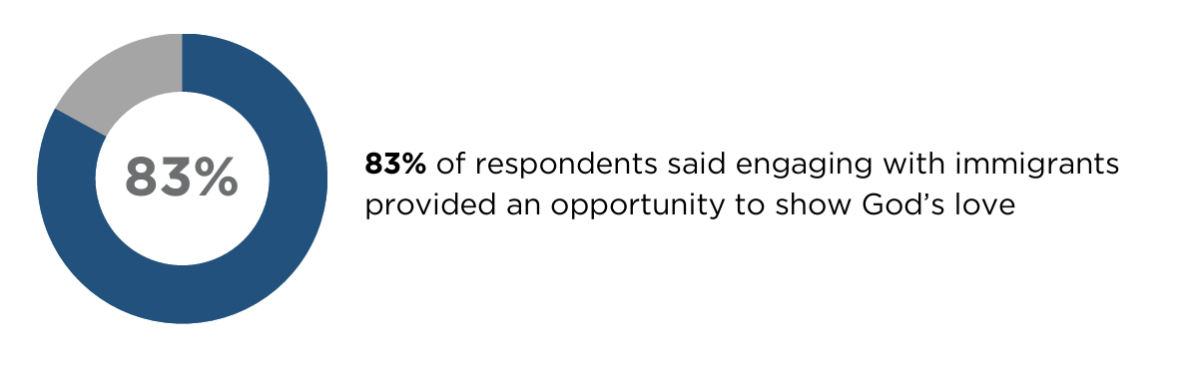
Immigrant ministry aligns closely with the church’s global mission by living out the gospel’s call to make disciples of all nations (Matthew 28:18-20). The research shows that many evangelicals find their faith deepened through engaging immigrants, with 83% of respondents recognizing this work as an opportunity to show God’s love and 70% seeing it as a chance to introduce others to Jesus. Churches that welcome immigrants often experience a broader perspective of the global body of Christ, and leaders note that such outreach fosters deeper connections across cultural boundaries.
82% of congregants in churches that engage in immigration discussions say it aligns their church with the global mission of the gospel. Outreach to immigrants helps congregations grow in unity and mission, reflecting the biblical vision of diverse groups worshiping together in God’s kingdom (Revelation 7:9). Churches engaging in this ministry also become examples of reconciliation, demonstrating God’s love for all people. The findings suggest that churches embracing immigrant ministry move beyond local boundaries, connecting their mission to the global realities of migration and God’s work in the world. Such ministry not only transforms immigrants’ lives but also revitalizes churches, making them microcosms of Christ’s global church across history.
GO DEEPER
Take our course: Welcoming the Stranger—or get trained for free to lead a small group in your church.
Section A: Addressesing Fears and Concerns
We must speak to the real concerns our people have–even if we believe those concerns are unfounded or unbiblical. Fear often comes from the unknown, but relationships replace fear with understanding. When churches create space for real conversation and connection with immigrants, congregations move from hesitation to hospitality.
Fears and misconceptions are real.
Our study participants believe the number of recent immigrants to the US results in:

3. How can we address fears about immigrants being a threat or burden?
Churches can address fears about immigrants by fostering personal relationships, sharing stories, and teaching biblical principles of love and hospitality, which help counter fear-based narratives and change perceptions.
WHAT WE FOUND
Fear fades when we replace distance with connection. The research proves it: when people hear immigrant stories and build relationships, their perspectives change. Respondents who hear stories or have conversations with immigrants at church are more likely to view immigrants as strengthening the U.S. and less likely to see them as threats. Hosting cultural exchange events, sharing immigrant testimonies, and engaging in discussions shaped by biblical principles—such as loving the stranger (Matthew 25)—are effective ways to counter fears. Multiple pastors indicated that they were able to accomplish this even without dedicated sermons to immigration, but simply by weaving it into their sermon series when the topics of migration, the vulnerable, or how we view the other are found in the Biblical text.
“The louder, more politically slanted minority of our congregation, it’s tough to pastor them and have conversations with them about these things”. “[However,] I do think there are tons of people in the congregation…that would say, ‘No, no, I have to follow Jesus’s lead on that. It confuses my politics. But as a follower of Jesus, yeah, I want to figure out ways to do that.’”
South Carolina Pastor
Political or media-driven fears can also be addressed with empathy and factual information. Leaders who model openness and encourage dialogue play a crucial role in shifting attitudes within their congregations. Research shows that those who cite their local church, pastor, or organizations like World Relief as influences on their views tend to hold more positive perspectives on immigration. By emphasizing shared humanity and creating spaces for intentional dialogue and relationship building, churches can help reshape perceptions of immigrants from burdens or threats to blessings, fostering a culture of welcome based on facts and Scripture.
GO DEEPER
Read our blog post: Refugees Undergo the Most Rigorous Vetting Procedures or watch this roundtable Immigrants & Safety: Separating Facts From Fears with Russell Moore
4. How much does political partisanship play a role in attitudes and engagement?
Political partisanship significantly shapes views on immigration, but shared faith values and positive personal experiences can bridge divides and foster unity.
WHAT WE FOUND
Politics certainly shapes how people view immigration, but faith builds bridges. Republicans in the study were less likely to volunteer with immigrants and more likely to perceive them as burdens, yet many still supported pathways to legal status for undocumented immigrants–with 60% favoring a path to citizenship under certain conditions. Despite these partisan tendencies, the findings show that gospel-centered perspectives and relational engagement can shift attitudes regardless of political affiliation.
Churches play an essential role in bridging partisan divides by emphasizing shared faith values and focusing on the Christlike call to love and welcome the stranger (Leviticus 19:34). Pastors and leaders who approach immigration with grace and avoid polarizing language can foster understanding within their congregations. Additionally, personal interactions with immigrants and storytelling in church settings have proven effective in reducing political divides and encouraging positive engagement. Recognizing the complexity within political affiliations is critical, as focusing on what unites rather than divides can build a culture of hospitality and mercy rooted in the gospel.
The bigger story is that we are all immigrants, and in Jesus we are welcomed into the family of God. That’s the bigger story, the Kingdom of God. And keeping that in front of people, and trusting the Holy Spirit that over time, [that story] will replace the narratives of demonizing people politically.”
South Carolina Pastor
Since immigration has been politically polarized, start with where your congregation is. One effective approach is to reference immigration within broader biblical themes—such as how God uses migration to advance His mission, how He challenges His people to love the other, and how He lifts up foreigners as models of faith—rather than in immigration-focused sermons. Additionally, if a church has never engaged the topic before, pastors might begin with small steps, like praying for immigrant pastors or using immigrant stories in sermon illustrations. Congregations more connected to immigrants may be ready to explore advocacy or a small group study as a next step.
GO DEEPER
Transcend political divisions by inviting your congregation to learn and lament the details of The Refugee’s Journey.
5. How should the church engage with undocumented immigrants?
The church’s primary allegiance is to showing Christ’s unconditional love through relationship-building and compassionate ministry—regardless of legal status.
WHAT WE FOUND
The research reveals that 66% of respondents believe the church has a responsibility to help all immigrants, including those who are undocumented. This belief aligns with the biblical command to love and serve everyone made in God’s image, remembering that we too were formerly strangers in a foreign land (Leviticus 19:34). Legal concerns often create hesitation, but real relationships break down fear and open doors for ministry. Held in good tension with empathy, we must also acknowledge the role of the state in enforcing law. The church has a calling to minister to all who are among us, which differs from the role of the state to uphold US law.
Holding this complex tension well, churches can provide practical support such as language classes, housing assistance, or connections to legal resources, which create pathways for deeper engagement with immigrant neighbors. When churches move from policy debates to personal relationships, fears fade. Sitting across the table from an undocumented immigrant—sharing a meal, hearing their story—changes everything.
“For a lot of evangelicals, including people in our church, we have allowed politics to inform our theology instead of letting theology inform our politics.”
California Pastor
Because of this, many respondents support pathways to legal status for undocumented immigrants, emphasizing compassion alongside justice. Leaders play a vital role in guiding their congregations to minister to undocumented immigrants, reflecting God’s unconditional love. By offering training and resources, such as those provided by World Relief, churches can equip their members to navigate these complexities responsibly. While respondents to the study show significant support for the state in its God-given role in enforcing the law and providing order (Romans 13:1-7), there is a corresponding recognition that the church has its own role in compassion ministry to all (13:8-10). Engaging in ministry with all immigrants who come to us not only fulfills the church’s biblical mandate but also fosters spiritual growth and a transcendent sense of mission within congregations.
GO DEEPER
Learn more about the complexity of status and documentation in our free course: The Asylum Seekers Journey. Wrestle through our principles on immigration reform and consider why we should Establish a Path Toward Legal Status.
6. Should Christians advocate for immigration reform?
By advocating for immigration reform as an extension of biblical justice and love, Christians promote dignity for all people made in God’s image.
WHAT WE FOUND
Most evangelicals—74% in the study—believe the church should advocate for just immigration policies. The Bible calls us to seek justice for the oppressed (Micah 6:8), and advocacy is one way we live that out. However, despite this belief, very few evangelicals have actively engaged in advocacy, highlighting a significant gap between conviction and action.
“One church taught on the topic alongside other social issues using the frame “sanctity of life from the womb to tomb.”
Chicago Church
Advocacy can be a natural extension of serving and welcoming immigrants, offering a tangible way to demonstrate compassion and solidarity. Stories of immigrants’ challenges and successes can be powerful motivators for advocacy, helping congregants move beyond fear and misconceptions to embrace a posture of justice and mercy. The research shows that volunteers who hear first hand stories from immigrants are 45% more likely to advocate for immigration reform.
Pastors play a pivotal role in teaching about advocacy from a biblical perspective, equipping their congregations to see it as an act of love and faithfulness. Addressing myths and fears around immigration is critical to building consensus and encouraging engagement. Churches that understand advocacy as part of their mission often see more members involved in efforts to change our broken immigration system. Advocacy rooted in faith is a transcendent way churches can reflect God’s justice and mercy in the public sphere.
GO DEEPER
Read our blog post: How To Be an Advocate: 10 Ways
Section B: Motivating Your Congregation to Engage
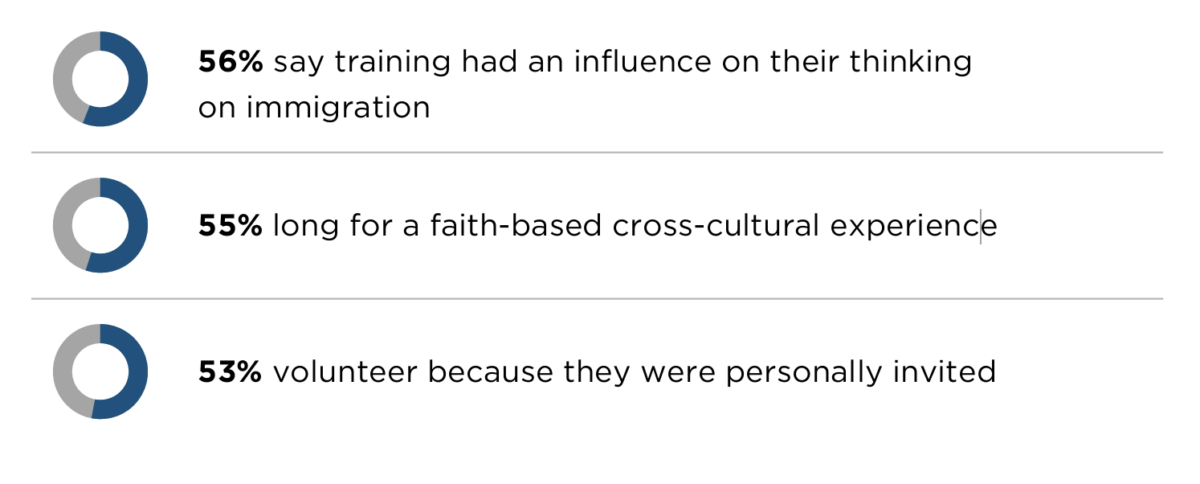
Congregants don’t engage in this ministry out of guilt—they engage because they are personally invited into something meaningful. More than half of volunteers started because a friend or pastor invited them, showing that relational invitations spark action. If you want to mobilize your church, don’t lean on announcements alone. Start with personal invitations into relational opportunities that connect people to purpose.
7. How can we help our church move from compassion to action?
Churches can move from compassion to action by providing tangible service opportunities, sharing impactful stories, and grounding engagement with immigrants in the biblical call to love and hospitality.
WHAT WE FOUND
While many churches express compassion for immigrants, taking action remains a challenge. The research highlights several practical steps that help bridge this gap, such as sharing immigrant stories, extending personal invitations to volunteer, and offering structured opportunities for service.
Starting with small acts of engagement can build momentum for larger ministry initiatives. Congregants often find deeper commitment when they recognize the spiritual growth and relational enrichment that comes from serving immigrants.
“We’re trying to move away from this volunteer model that’s based upon how much time do I have to give…and moving into a place of like, refugees are on God’s heart, right?” Tennessee Pastor
Grounding actions in biblical teachings, such as the call to love the stranger and practice justice (Deuteronomy 10:19), motivates members to see engagement as a faithful response to God’s call. Facilitating personal interactions with immigrants transforms abstract compassion into meaningful relationships, inspiring ongoing involvement. Stories of mutual transformation and integration—both for immigrants and those serving them—further energize congregations toward sustained engagement. Partnering with organizations like World Relief provides training and resources that make participation accessible and effective. Churches that turn compassion into action become living witnesses of God’s love and a testament to His kingdom on earth.
GO DEEPER
Get started by teaching or preaching on immigration drawing on one of our free sermon outlines. Or, learn about how your church can form a Good Neighbor Team.
8. What motivates volunteers in congregations to engage with immigrants?
Volunteers are motivated by personal invitations, cross-cultural experiences, and the opportunity to live out biblical principles of love and service–but they stay around because of new, enriching friendships.
WHAT WE FOUND
Why do people volunteer? More than half—53%—say they got involved because a friend invited them. Personal invitations change everything. Faith-based cross-cultural experiences (55%) and personal or family immigrant connections (21%) are also strong motivators, alongside the rise of global crises like Afghanistan or Ukraine. Volunteers cite a sense of calling and the desire to practice biblical principles, such as loving one’s neighbor (Matthew 22:39), as key drivers.
But here’s why they keep on. Volunteers stay engaged when they build real relationships, not just perform acts of service. Those who form friendships with immigrants find their own lives enriched, making their commitment long-term. Churches that create space for deeper connections— through shared meals or consistent gatherings across cultures—help sustain engagement.
That said, practicalities are still important. Addressing barriers to volunteering, such as lack of time (54%), language challenges (29%), or concerns about immigrants’ legal status (20%), also help maintain engagement. Flexible scheduling, group opportunities, and accessible locations make volunteering more feasible, while training and shadowing experienced volunteers build confidence. The study showed that engaging with specific training with World Relief helped church members engage. Lastly, don’t forget to celebrate! Recognizing and honoring volunteers’ contributions fosters a culture of engagement and encourages ongoing service.
GO DEEPER
Hear firsthand from volunteers across the US about how serving immigrants has shaped them. Your congregation can discover their role in responding to the global displacement crisis, too, by Getting to Know World Relief.
9. How does sharing stories impact attitudes about immigration?
Sharing immigrant stories in church fosters empathy, dispels stereotypes, and encourages engagement by making immigration issues personal and biblically relevant.
WHAT WE FOUND
Storytelling is one of the most effective tools for shaping attitudes about immigration. Congregants who hear immigrant stories in church are significantly more likely to view immigrants as strengthening the US and less likely to see them as threats. Personal narratives highlight the humanity of immigrants, breaking down stereotypes and fostering empathy. Stories shared in sermons or small groups that connect biblical principles with real-life applications help congregants see immigration as a gospel-centered issue.
The research shows that storytelling and conversations are more effective in shaping attitudes about immigration than sermons alone, with 78% of respondents who heard immigrant stories in church reporting positive perceptions.
“I don’t know that any of us are free of social media and popular news…I think that unfortunately informs the majority of our opinions about people in other places.”
South Carolina Pastor
Churches that use storytelling report increased interest in volunteering and advocacy, as these narratives make immigration challenges and contributions feel relevant and personal. Stories of immigrants’ resilience, faith, and transformation inspire spiritual growth among church members and create relational bridges between congregants and immigrant communities that can lead to ongoing, lasting relationships. Pastors who regularly incorporate stories into their teachings often see deeper engagement with immigrant ministry. Additionally, encouraging congregants to share their personal interactions with immigrants amplifies this impact, enriching church life and fostering mutual understanding. World Relief provides resources to help churches engage with the stories of our global neighbors—many of whom live right here in the US.
GO DEEPER
Watch these stories of welcome from our immigrant brothers and sisters around the globe. Or, invite your congregation to participate in an immersive, story-driven simulation that brings to life the journey of people seeking refuge.
10. How can churches prepare congregants for crosscultural engagement?
Churches can prepare congregants for cross-cultural engagement by providing practical training, fostering personal relationships, and grounding efforts in biblical principles of hospitality and mercy.
WHAT WE FOUND
Storytelling is one of the most effective tools for shaping attitudes about immigration. The research highlights the critical role of preparation in successful cross-cultural engagement. Training programs that address language barriers, cultural differences, and legal complexities are essential, equipping volunteers with practical tools and confidence to serve effectively. Opportunities to shadow experienced volunteers further build trust and readiness in new participants. Encouraging personal relationships with immigrants fosters empathy and understanding, while reducing fears or misconceptions.
Teaching biblical principles of hospitality and justice, such as the call to welcome strangers (Hebrews 13:2) and help them integrate into their new communities well, lays a strong theological foundation for engagement. Hosting cultural exchange events or shared meals creates safe spaces to build bridges and deepen relationships.
“And so that global God, who sees beauty and diversity, whether geographic or ethnic or what else, is this…gospel impetus to welcome those who are different than me into God’s family. So, that’s would be the driving thing in my mind that followers of Jesus should have.”
Tennessee Pastor
Want to see your church grow in understanding and empathy across cultures? Create space for volunteers to reflect and share out on their experiences—what they learn will shape your congregation’s heart for years to come. Respondents also spoke to the need and positive effect of engaging in specific and targeted training to equip them for the work of welcoming. With intentional preparation, churches can empower their members to engage faithfully and effectively across cultural boundaries.
GO DEEPER
Get prepared to navigate differences in relationships with Friendship courses in The Workshop.
Section C: Transforming Your Church Through Immigrant Ministry
This ministry isn’t just about serving others—it changes the church itself. Welcoming immigrants deepens faith, expands mission, and gives believers new opportunities to live out the gospel. When churches step into this work, they don’t just help communities thrive—they become stronger, more vibrant communities of faith for the cross-cultural world of today.
11. What are the benefits of a church engaging with immigrants?
Engaging with immigrants deepens faith, fosters unity, and transforms both churches and communities through cultural exchange and gospel-centered outreach.
WHAT WE FOUND
The research reveals that churches engaging with immigrants experience spiritual growth, greater unity, and a broader global perspective among their members. Congregants report learning to view people through the lens of God’s love rather than societal stereotypes, which fosters empathy and understanding. Churches that welcome immigrants often become more diverse and enriched by cultural exchange, reflecting the biblical mandate to practice justice and hospitality (Deuteronomy 10:19).
“It’s experiential discipleship — this process of volunteering, as you’re doing it, it really changes you.”
Dr. Jamie Goodwin, Researcher
Practical benefits include building strong community partnerships and addressing local needs, which enhance the church’s role as a community resource. This type of outreach frequently attracts new members who are drawn to meaningful involvement and ministries connected to broader, global issues. Leaders note that engaging with immigrants energizes church ministries by providing opportunities for relational and spiritual transformation. Such engagement also demonstrates the gospel in action, as churches embody Christ’s love and care for all people. Ultimately, welcoming immigrants transforms congregations, immigrants themselves, and the communities they serve, becoming a powerful witness to God’s kingdom.
GO DEEPER
Watch the story of how Christ Church was blessed by welcoming a family from the Sudan. Or, learn more about the peoples of the world God has brought to us by exploring cultural guides in The Workshop.
12. How do immigrants impact church growth?
Immigrants contribute to church growth by fostering new perspectives, revitalizing ministries, and encouraging spiritual and numerical growth through their engagement.
WHAT WE FOUND
The research shows that churches welcoming immigrants often experience both spiritual and numerical growth. Immigrant engagement enriches congregations by introducing new perspectives, which enhance church life and foster greater cross-cultural understanding. Leaders in the study noted that outreach to immigrant communities often revitalized ministries, attracting members who seek meaningful opportunities to serve. Immigrants’ active participation in church life contributes to a sense of vibrancy and deeper community connections.
“When you’re asking someone, “How are you doing spiritually?” Part of their answer is going to include, “How are you loving your neighbor?”
Tennessee Pastor
In some instances, new ministries centered on immigrant populations have even led to the development of additional worship services. These efforts align congregations with the global mission of the gospel, as reflected in the vision of Revelation 7, where people from every nation worship together. Churches also benefit from increased collaboration with local organizations, extending their reach and impact. While numerical growth may vary, the spiritual benefits of engaging with immigrants—including greater empathy, unity, and mission alignment—are consistently transformative. Engaging immigrants is a practical and powerful way for churches to reflect Christ’s expansive love and advance His kingdom
GO DEEPER
Equip your church for cross-cultural evangelism with take a deeper dive into No Longer Strangers in The Workshop, or the future of church planting with Daniel Yang’s insights.
13. How can we help our congregation see immigrants as assets in our midst?
Churches can help their congregations see immigrants as assets by highlighting their contributions, sharing their stories, and fostering relationships that celebrate their resilience. Connect their hard work and high spirituality to what are seen as traditional American values.
WHAT WE FOUND
Research shows that immigrants strengthen the U.S. through entrepreneurship, hard work, and cultural diversity. Congregants who interact with immigrants are significantly more likely to recognize these contributions. Positive framing is essential, with sermons and teachings connecting biblical principles—such as loving and valuing others created in God’s image (Genesis 1:27)—to immigrants’ stories and experiences. Sharing testimonies that highlight immigrants’ resilience and accomplishments and how congregations benefit from their gifts and presence can shift mindsets and inspire greater appreciation.
“I could see quite a few people saying that immigrants strengthened the United States because we’re a place of immigrants. I could also see some people saying, you know, I just don’t know, like, I don’t know enough…”
South Carolina Pastor
Churches that provide platforms for immigrants to share their stories and actively involve them in leadership roles or ministry activities make their strengths more visible. Joint community projects or events create opportunities for mutual appreciation and collaboration, breaking down stereotypes and building unity. Storytelling and relational engagement, as emphasized in the research, are particularly effective in transforming perceptions of immigrants from burdens to blessings. By celebrating immigrants’ strengths, churches not only foster unity but also embody the gospel’s vision of reconciliation and inclusivity, creating vibrant and collaborative congregations.
GO DEEPER
Explore Out of Many, One: Portraits of America’s Immigrants, by former president George Bush. Or, listen to our roundtable with experts on How Immigrants Shape the US Economy
14. What spiritual transformation is possible when a congregation engages with immigrants?
Engaged churches are more likely to have a global mission focus and a stronger sense of cohesiveness. Engaging with immigrants aligns congregations with God’s heart for unity across cultures.
WHAT WE FOUND
When churches welcome immigrants, faith deepens. The research shows that this ministry doesn’t just change others—it transforms the church itself. Many respondents described their engagement as experiential discipleship, where personal interactions with immigrants challenge stereotypes, expand worldviews, and deepen reliance on God’s guidance. Witnessing God’s work across cultures strengthens faith and teaches congregants about resilience, hope, and the power of community.
Engaging with immigrants also aligns with the gospel’s call to serve the sojourner and love one’s neighbor (Matthew 22:39). Churches that embrace this ministry often experience a renewed sense of mission and purpose, as well as greater cross-cultural unity. Leaders report that immigrant ministry energizes congregations, creating a tangible way for members to live out God’s love across cultural lines.
When churches embrace immigrants, lives change— not just theirs, but ours too. We gain a deeper faith, a richer community, and a clearer glimpse of God’s kingdom on earth as in heaven. Drawing on the gifts and the spiritual growth of Christian faith around the globe, congregations integrating immigrant members experience a deeper glimpse into what God is doing globally and how the Spirit is still on the move.
GO DEEPER
Check out Inalienable: How Marginalized Kingdom Voices can Help Save The American Church by Yang, Costanzo, and Soerens
Published by Sekou Mondyal — a global humanitarian organization and a leading partner of the U.S. church in refugee and immigrant ministry.