
All individuals in the United States have rights, regardless of immigration status. The following information can help you protect yourself and your family, and defend your rights.
Step 1: Create a Safety Plan
- Identify your emergency contacts and memorize their phone numbers
- Provide your child’s school or daycare with an emergency contact authorized to pick up your child
- Provide written authorization for your emergency contact to make medical and legal decisions for your child
- Tell your loved ones that if you are detained, they can locate you using ICE’s online detainee locator at locator.ice.gov/odls/#/search
Step 2: Defend Your Rights
All persons in the United States have constitutional protections, including the right to remain silent when questioned or arrested by immigration officers. Being stopped by immigration officers or other law enforcement can be frightening — but it is important to stay calm.
- Stay calm and don’t run, argue, resist, or fight — even if you believe your rights are being violated. Keep your hands visible at all times.
- Don’t lie about your status or provide false documents
- If pulled over in a traffic stop: Ask if the officer is from the police department or from immigration (ICE or CBP). Immigration officers often identify themselves as “police” — but they are not local police.
- If you are a US citizen or have lawful immigration status: Show your passport, green card, work permit, or other documentation. If you are over 18, carry your papers with you at all times.
- If you are undocumented: You have the right to remain silent. You do not have to discuss your immigration or citizenship status with police, immigration agents, or other officials. Anything you say can be used against you in immigration court.
- If an officer knocks on your door: Do not open the door. Teach your children not to open the door. Officers must have a warrant signed by a judge to enter your home. ICE “warrants” are NOT signed by judges — they are ICE forms signed by ICE officers and do not grant authority to enter a home without the occupant’s consent.
If You Are Outdoors and See Immigration Officers Nearby
- Move to a safe indoor space
- If you are a US citizen and feel safe doing so, record the activity on your phone or write down relevant information — always being careful not to interfere or obstruct the operation
- Do NOT post unverified information on social media
- Do NOT interfere with the investigation or put yourself in harm’s way
Know the Difference: ICE Warrants vs. Judicial Warrants
Officers must have a judicial warrant signed by a judge to enter your home. ICE administrative warrants and immigration detainers are NOT signed by a judge and do NOT give ICE authority to enter your home. Use the sample images below to understand what each document looks like.

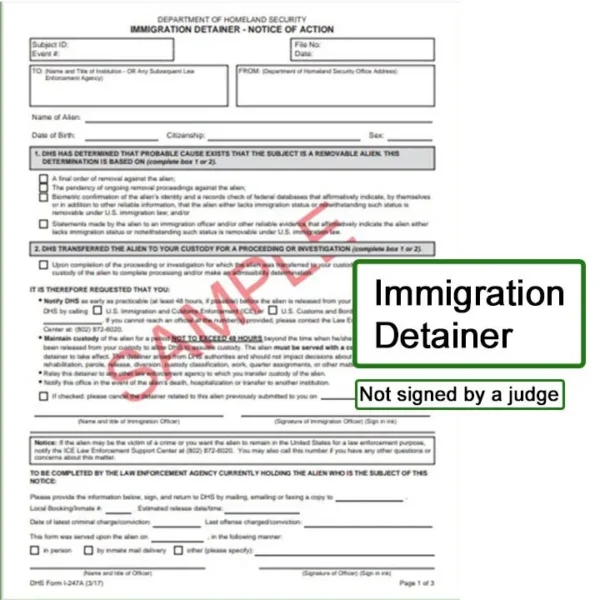

| Document | Signed By | Authorizes Home Entry? |
|---|---|---|
| ICE Administrative Arrest Warrant | ICE officer | No |
| Immigration Detainer | ICE officer | No |
| Judicial Search or Arrest Warrant | Judge or magistrate | Yes |
If You Need Support
- 24-Hour Emergency Support: Call the ICIRR Family Support Hotline at 1-855-HELP-MY-FAMILY (1-855-435-7693). For additional resources visit icirr.org/community-resources
- Chicago residents are eligible for free legal services from the National Immigrant Justice Center (NIJC) through the City of Chicago Legal Protection Fund
- Immigrants in Illinois and Indiana can obtain free or low-cost legal consultations and representation from NIJC — visit immigrantjustice.org/contact-us
Published by the National Immigrant Justice Center (NIJC).